Most Charlotte parents evaluate after school programs and classes on logistics first: location, hours, and cost. Those details matter, but they do not predict whether a program actually develops your child. After school hours represent more than 20 hours per week of potential development time. The difference between a passive childcare environment and a structured development program compounds over months and years, showing up in a child’s confidence, social skills, physical fitness, and willingness to take on challenges. Whether your child is drawn to martial arts, sports, dance, tennis, or adventure-based enrichment, the quality of instruction and structure matters far more than the specific activity.
According to the Afterschool Alliance‘s America After 3PM report found that demand for after school programs far outstrips supply, with parents of nearly 30 million school-age children wanting programs for their kids. Yet quality varies enormously among the programs that do exist. The Child Mind Institute emphasizes that the after school hours are a critical window for social skill development, particularly for children who need more in-person practice than the school day provides. This guide walks through what separates a genuinely effective after school program from one that is simply filling time.
Summary: After School Programs in Charlotte NC
The best after school programs in Charlotte combine qualified instructors, structured programming, age-appropriate grouping, rotating content, and a focus on the whole child rather than just academics or athletics. This guide covers each criterion, identifies red flags, compares Charlotte’s major program categories, including martial arts studios, sports leagues, dance academies, tennis clubs, and adventure-based enrichment, and uses Mission Grit’s XPLOR Program as a benchmark for what adventure-based, character-focused after school programming looks like in practice.
Key Points
- Quality programs develop the whole child: Physical, mental, social, and character skills simultaneously, not just one dimension. The best programs blend physical activities like martial arts, sports, or obstacle courses with structured social and leadership development.
- Instructor background matters more than facility size: Ask about staff qualifications, experience, and turnover rate before evaluating equipment or space.
- Rotating content keeps kids engaged: Programs with weekly content changes retain children longer and produce better developmental outcomes than static schedules.
- Non-competitive environments serve more kids: Children who disengage from competitive sports often thrive in structured, non-competitive physical programs.
- Red flags to watch for: passive supervision, high staff turnover, no parent communication, no age grouping, and closed-door policies for parent observation.
- Mission Grit’s XPLOR Program: the standout adventure and character-development after school option in Charlotte for K-8th grade, located at 6311 Carmel Rd. Learn more about XPLOR.
| See What Structured After School Programming Looks Like
Mission Grit’s XPLOR Program runs 60-minute weekly sessions for K-8th grade, with new students welcome any week. View the XPLOR program details. |
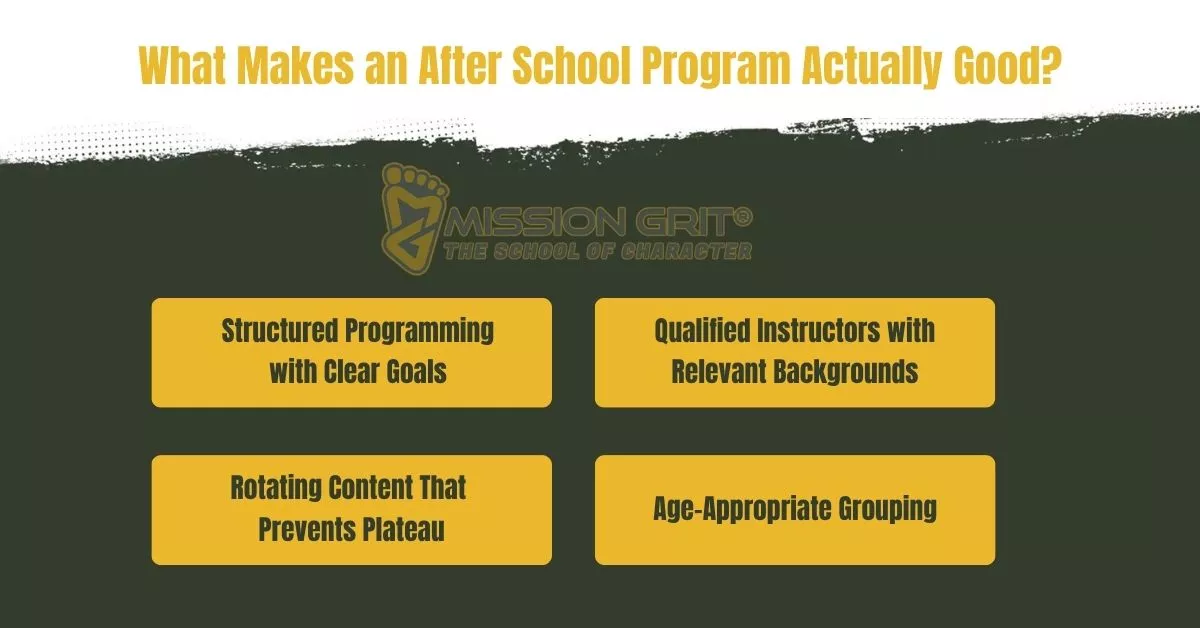 What Makes an After School Program Actually Good?
Structured Programming with Clear Goals
The Afterschool Alliance’s America After 3PM report consistently finds that programs with defined learning outcomes outperform supervised-play models on every measurable metric: academic performance, social development, physical activity, and family satisfaction. The question to ask is not “what does my child do after school?” It is “what will my child be able to do in three months that they cannot do today?”
Mission Grit’s XPLOR Program answers that question through its four-dimension framework: every session develops physical skill, mental problem-solving, social cooperation, and character resilience. This is not a checklist that covers one area per week. All four dimensions are woven into every 60-minute class through obstacle courses, team challenges, and structured debriefs. Unlike single-discipline programs such as a martial arts dojo or a tennis academy that focus on one skill set, XPLOR integrates multiple development areas in every session.
Qualified Instructors with Relevant Backgrounds
The single biggest predictor of program quality is the instructor. Look for real-world backgrounds that translate directly to child development: military leadership, competitive athletics, formal education in child development, or experience in experiential learning. Then ask about turnover. High turnover breaks the continuity that children need to build trust with adults and take the kind of risks that produce growth.
At Mission Grit, every instructor is a military veteran with additional training in child development and fitness. The veteran background is not decorative; it produces a specific kind of leadership: calm under pressure, skilled at reading hesitation, and trained to build people up through challenge rather than correction. This is why Mission Grit’s instructors are able to reach children who have disengaged from other programs, whether those were sports teams, dance classes, or martial arts studios.
Age-Appropriate Grouping
A program that groups a 6-year-old with a 13-year-old is not designed for either child’s benefit. Effective grouping accounts for physical capability, social maturity, and developmental readiness. Mission Grit’s XPLOR tiers reflect this: K through 2nd grade focuses on coordination and confidence fundamentals. 3rd through 5th grade introduces complex tasks and adaptability. 6th through 8th grade layers in leadership development and more intense physical challenges. Each tier is taught differently because each age group learns differently.
Rotating Content That Prevents Plateau
Static weekly schedules produce engagement drop-off within six to eight weeks. Children who face the same activities in the same order stop being challenged and start going through the motions. Programs that actively rotate content, redesign challenges, and introduce fresh themes on a weekly cycle signal active program design and retain children significantly longer.
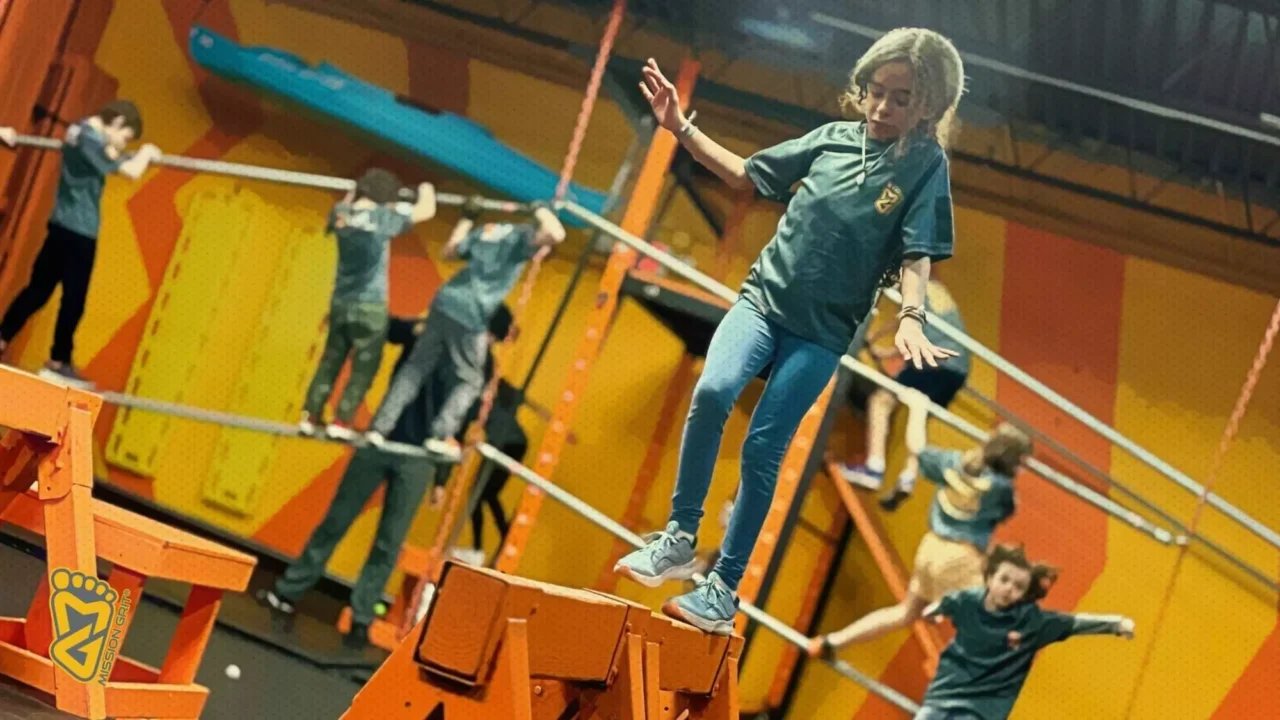
Mission Grit rebuilds its obstacle courses every week. No child faces the same course twice. This approach keeps long-term students continuously challenged while ensuring that new students are never at a disadvantage against children who have memorized a fixed layout.
| Tour Mission Grit Before You Enroll
Quality programs welcome parent observation. Contact the Charlotte location at 704-733-9103 to schedule a visit and see a session in action. |
Why Non-Competitive After School Programs Work for More Kids
The Aspen Institute’s Project Play research found that the average age a child quits organized sports is 12, with “it’s not fun anymore” cited by 39% of respondents. Competitive pressure from coaches and parents was the second-most cited reason at 28%. These statistics point to a structural problem: traditional competitive environments lose a large portion of children before they reach high school. This applies across sports, dance competitions, tennis tournaments, and martial arts belt-ranking systems alike.
Non-competitive does not mean unchallenging. It means the challenge is personal rather than comparative. At Mission Grit, every child competes against their own previous performance, never against other children. There are no scoreboards, no rankings, and no elimination rounds. The CDC recommends 60 minutes of moderate-to-vigorous physical activity daily for children ages 6 through 17, and Mission Grit delivers that in an environment designed to keep every child engaged, not just the ones who already excel at sports.
For children who have already disengaged from competitive athletics, dance recitals, or martial arts tournaments, or never connected with them in the first place, a non-competitive after school program is often the environment where they discover they enjoy physical challenge. The difference is the absence of public comparison. When no one is watching a scoreboard, the child who is slower, smaller, or less coordinated stops being “behind” and starts simply working on their own growth.
Red Flags to Watch for When Evaluating After School Programs
Not every program that looks professional on a website delivers in practice. Here are the warning signs that a program is filling time rather than building skills.
- Passive supervision over active instruction: If children spend most of their time on devices, in free play, or watching videos, the program is paid childcare, not development. Ask what a typical session looks like minute by minute.
- No parent communication or progress updates: Quality programs give parents visibility into what children are doing and how they are developing. If you only hear from the program about billing, that tells you where their focus is.
- High staff turnover: Ask directly. If the instructor your child builds a relationship with is gone in two months, the developmental continuity breaks. Programs with consistent teams signal organizational health.
- No age grouping: One-size-fits-all programming treats children as a logistics problem, not a developmental opportunity. If kindergartners and middle schoolers share the same session, the program was not designed with child development in mind.
- Closed to parent visits: Any program that discourages or prevents parent observation before enrollment should be questioned. Programs confident in their quality welcome visitors.
After School Options in Charlotte NC: Category Overview
Academic Enrichment
Programs like Kumon, Sylvan, and Mathnasium focus on targeted academic support in math, reading, and test preparation. These are strong options for children who need specific academic intervention, but they provide limited physical activity, social development, or character building. For families whose primary need is homework help or subject-area tutoring, academic enrichment programs serve that purpose well. They are not designed to develop the whole child.
Traditional Sports and Recreation
The YMCA, Charlotte Parks and Recreation, and sport-specific leagues offer after school sports programming, from soccer and basketball to tennis and swimming. These work well for children who are already engaged in a specific sport and enjoy competitive environments. The limitation, as the Aspen Institute’s research documents, is that competitive structures exclude a significant portion of children who do not thrive in ranked or scored environments. For the child who loves movement but not competition, traditional sports programs may actually accelerate disengagement from physical activity.
Arts and Creative Programs
Art studios, music schools, dance academies, and theater programs develop creative expression, fine motor skills, and emotional vocabulary. They are excellent choices for expressive children and can build confidence through performance and creation. The trade-off is lighter physical activity and less emphasis on leadership and team-based problem solving.
Martial Arts Studios
Martial arts programs in Charlotte, from taekwondo and karate to jiu-jitsu, offer discipline, physical conditioning, and a belt-ranking progression system. They are strong options for children who respond well to structured individual advancement. The emphasis is typically on personal discipline and technique mastery, with less focus on team-based problem solving and collaborative leadership development.
Adventure-Based and Character Development
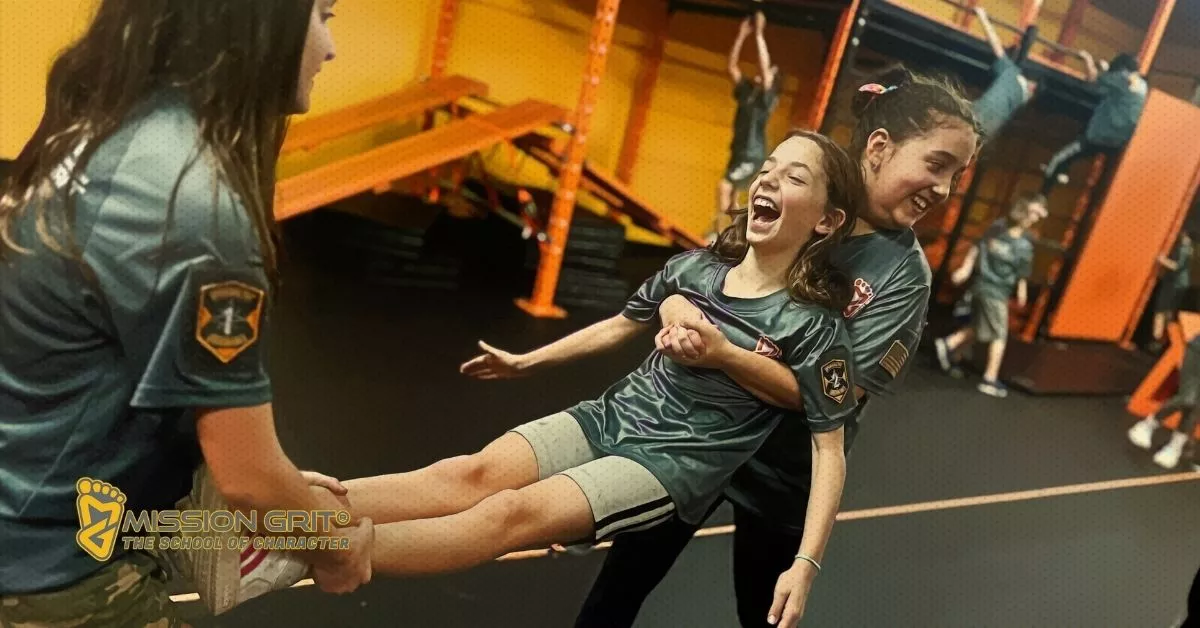
This is the category Mission Grit’s XPLOR Program occupies. The program runs 60-minute weekly sessions for K through 8th grade at the Charlotte facility (6311 Carmel Rd, Suite C, Charlotte NC 28226). Every session combines obstacle courses, team challenges, relay activities, and character instruction under the S.P.I.R.I.T. Method: Science, Problem Solving, In-Motion, Respect, Interactive, and Teamwork.
The XPLOR Program is not a gym class and not a sports league. It is structured character development delivered through physical challenge. Courses rotate weekly. Instructors are military veterans. The environment is non-competitive. And families in the South Charlotte area can also access the Fort Mill, SC location at 9499 Old Bailes Rd, Suite 205 (803-632-0279) for the same curriculum.
| Compare After School Options for Your Child
Every child responds to a different type of program. If your child thrives on physical challenge but not competition, explore the XPLOR Program or read more about after school activities in Charlotte. |
 Questions to Ask at Your Next Program Tour
Before enrolling your child in any after school program in Charlotte, ask these questions. The answers will tell you more about quality than any website or brochure.
- What is your instructor-to-child ratio? Lower ratios mean more individual attention. Programs with ratios above 1:10 for active physical programming cannot provide meaningful coaching.
- How do you group kids by age or ability? Look for at least three tiers. A program that does not differentiate between a first grader and a seventh grader is not developmentally informed.
- Does programming change week to week? Static content signals a maintenance program. Rotating content signals an active development program.
- How do you communicate progress to parents? Regular updates, even informal ones, indicate a program that tracks growth rather than just attendance.
- What is your staff turnover rate? This question makes some program directors uncomfortable. That discomfort is information.
- Can I observe a session before enrolling? Any program that says no to this should be removed from your list immediately.
6 Signs You Have Found the Right After School Program
For Charlotte parents evaluating options, here is what quality looks like in practice.
- Your child asks to go back. Engagement is the most reliable indicator. A child who voluntarily wants to return is a child who feels challenged, supported, and respected.
- You see specific skills developing. Not vague “they had fun” reports, but observable changes: better conflict resolution, more confidence with physical challenges, improved communication.
- Instructors know your child by name and personality. This indicates manageable ratios and relationship-based instruction.
- Programming changes regularly. Your child describes different activities week to week, not the same routine.
- The program communicates proactively. You hear about your child’s progress without having to ask.
- Your child transfers skills to other settings. The teamwork and leadership practiced at the program shows up at school, at home, and with friends, whether they came from martial arts, sports, dance, or an adventure-based program like XPLOR.
Mission Grit’s XPLOR Program checks every one of these boxes, which is why it holds a 5.0 rating from 157+ reviews and why families who enroll tend to stay enrolled.

Conclusion
The right after school program builds skills your child carries into school, relationships, and adulthood. It is not just a place to be until dinner. Charlotte has strong options across every category, from martial arts and dance to sports leagues and academic tutoring, and the best choice depends on your child’s temperament, interests, and developmental needs.
For families looking for a program that combines physical challenge, social skill development, character building, and fun in a non-competitive, veteran-led environment, Mission Grit‘s XPLOR Program is the standout option. Founded by Paul Plotkin, a military veteran who built the program on the conviction that children develop character through challenge, XPLOR has become Charlotte’s go-to after school program for families whose children need more than academics or sports can offer alone.
| Enroll in Mission Grit’s XPLOR Program
The XPLOR Program is enrolling K-8th grade at both Charlotte and Fort Mill locations. New students can join any week. View the XPLOR program, or call Charlotte at 704-733-9103 or Fort Mill at 803-632-0279. |