
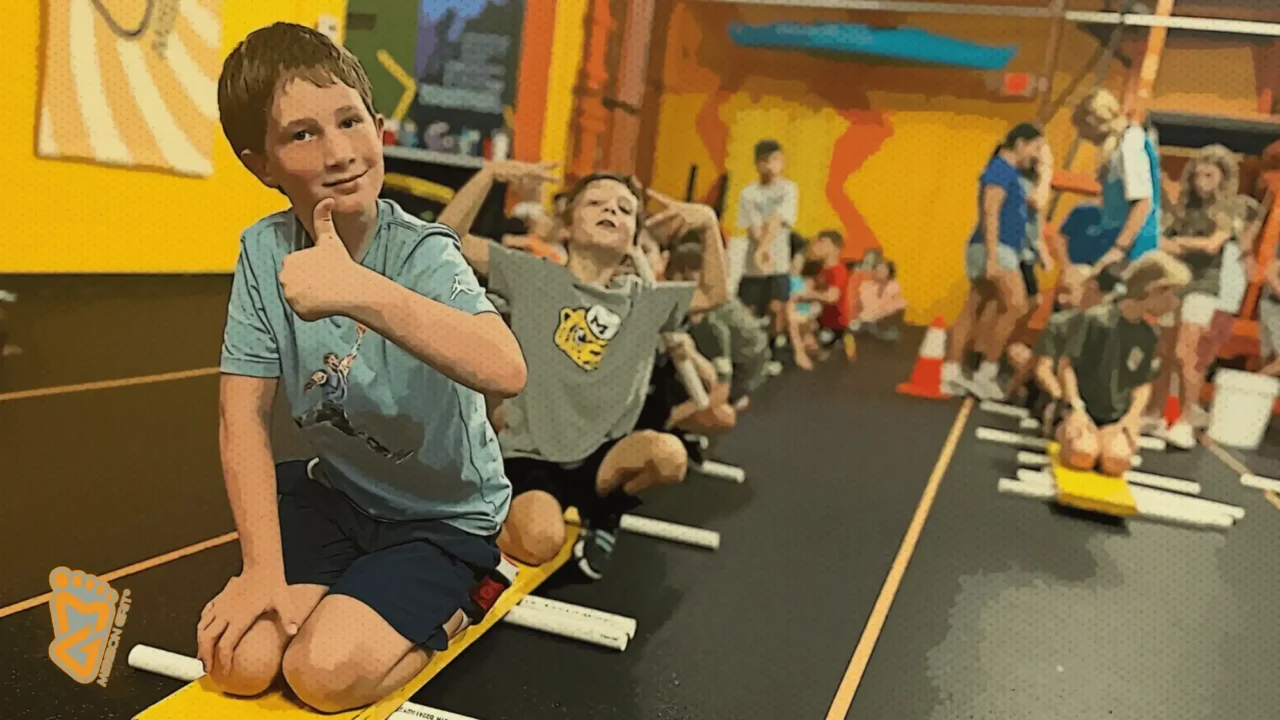
Parents looking for after-school programs for kids with ADHD in Charlotte, NC usually figure out the problem in the 3:00 pickup line. Their child has already spent six or seven hours being asked to sit, wait, focus, and stay quiet. The homework-help room asks for the same thing, for two more hours. By dinner, nobody in the house has anything left.
ADHD isn’t rare, and it’s not a scheduling problem to work around. What these kids need in the afternoon isn’t more sitting, and it isn’t an unsupervised free-for-all either. They need real structure and real movement in the same hour. Mission Grit built its Xplor obstacle course classes around that combination, and this post covers what structure actually means when you’re evaluating a program, why the type of movement matters more than the amount, and the practical details on days, ages, locations, and cost.
Also Read
- Kids Obstacle Course Classes in Charlotte: What the Xplor Program Looks Like
- How Mission Grit’s Obstacle Courses Build Confidence for Non-Athletic Kids in Charlotte
- Kids Fitness Classes in Charlotte and Fort Mill: Building Strength Without Competitive Sports
TL;DR
Kids with ADHD tend to struggle in after-school programs that ask for stillness and do better in ones that hold a predictable frame around an hour of hard physical problem-solving. Research on physical activity and ADHD points specifically to open-skill movement: activities where the task keeps changing, and the child has to read the situation and adapt, rather than repetitive drills. Mission Grit’s Xplor program runs 45-minute obstacle course classes for kids in kindergarten through 8th grade in Charlotte and Fort Mill, grouped by age, on a fixed weekly schedule, with the course and the challenge theme changing session to session. Monthly plans start at $110 for one class a week, and you can book a single trial class before committing to anything.
Key Points
- Structure and movement aren’t opposites. The programs that work best hold a tight, predictable frame around the hour, then fill it with hard physical problems. The routine removes the guesswork; the movement gives the body somewhere to put the energy.
- ADHD is common enough that most Charlotte classrooms have several students with it. The CDC puts current ADHD diagnoses at roughly 7 million U.S. children ages 3 to 17.
- The kind of movement matters as much as the amount. A meta-analysis of 24 studies found that open motor skill activities, where the environment keeps changing, improved inhibitory control, working memory, and cognitive flexibility in kids with ADHD. Closed, repetitive activities improved inhibitory control but not the other two.
- A changing course is the point, not a gimmick. Rotating the obstacle layout and the challenge theme means a child can’t autopilot through it, which is exactly the open-skill condition.
- Short blocks beat long ones. Xplor classes run 45 minutes, long enough to get real work done and short enough that a child finishes on a win instead of falling apart in the last twenty minutes.
- Age-based teams reduce the social friction. Grouping keeps a second grader from trying to hold pace with a seventh grader and keeps a middle schooler from being bored.
- Predictable routine is standard ADHD guidance. The CDC lists keeping the same daily schedule among its recommended behavior-management strategies, and a fixed weekly class slot is one of the easiest places to apply it.
- You can test the format before you enroll. A trial class lets you watch how your child handles it before you sign up for a month.
See how your child does in a real class first. One 45-minute session tells you more than any program description will. Book a trial class in Charlotte or Fort Mill.
Why Sitting Still Is the Wrong Ask at 3 PM
An estimated 7 million U.S. children ages 3 to 17, about 11.7 percent, have a current ADHD diagnosis, according to 2024 national survey data reported by the Centers for Disease Control and Prevention. In a district the size of Charlotte-Mecklenburg, that’s several children in most classrooms, and all of them hit 3:00 PM with the same problem.
The school day has already spent the attention budget. A homework room asks a child with ADHD to spend from an empty account, which is why so many of those afternoons end in a standoff at the kitchen table. The child isn’t being defiant. He’s being asked for something he doesn’t have left.
The opposite extreme doesn’t work either. Unstructured gym time releases energy but doesn’t build the skill of directing it, which is why open-play programs tend to produce the same result every week: an exhausted child and no change in behavior at home. The option that works sits between the two: a structured hour with real physical demand.
The trade-off parents worry about—that time spent moving is time taken from schoolwork—doesn’t hold up well. A CDC review of 50 studies on school-based physical activity and academic performance found that recess has a positive or neutral relationship with children’s attention, concentration, and on-task classroom behavior, and that adding time for physical education doesn’t appear to hurt academic performance.
What to watch for on a tour
Ask what the child is physically doing during each fifteen-minute block of the program. If more than one block is seated, the fit is unlikely. Ask what happens when a kid needs to move mid-activity, and listen for whether the answer involves redirection or a built-in outlet. A program whose only tools are quiet time and redirection will eventually label a child disruptive for doing what his body is telling him to do.
What Structure Actually Means in a Kids’ Program
“Structured” shows up on nearly every after-school program page in Charlotte, NC, and it means very different things. Here’s what it should mean.
Same day, same time, same room. Predictability lives in the frame, not the content. Knowing the class is always Thursday at 5:30 in the same space removes a whole layer of anticipatory anxiety before the child walks in. This isn’t a marketing idea. The CDC’s own behavior management guidance for parents of children with ADHD leads with creating a routine and following the same schedule every day.
A visible sequence to the hour. Warm-up, instruction, the course, the team challenge, the close. Kids who struggle with transitions do better when they can see where they are in the arc and how much is left.
Instructor-led rather than supervised. There’s a real difference between an adult running an activity and an adult watching a room. Xplor classes are coached start to finish, which means a child who needs a cue gets one.
Clear, repeated expectations. Mission Grit’s S.P.I.R.I.T. method, which stands for Science, Problem Solving, In Motion, Respect, Interactive, and Teamwork, gives instructors a consistent vocabulary. A child hears the same standard from every coach, every week.
A defined end. Forty-five minutes with a clear finish is far easier for a child to hold together than an open-ended two hours.
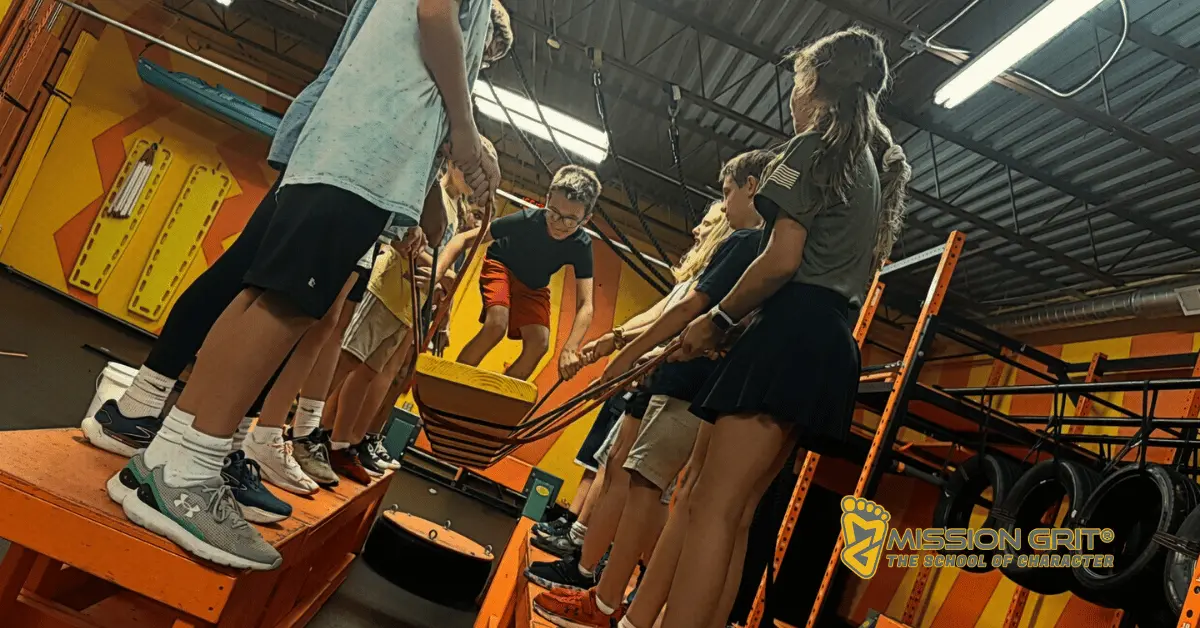
Why a Changing Course Beats a Repetitive Drill
This is the part most parents haven’t heard, and it’s the strongest argument for an obstacle course over a running club.
A 2023 meta-analysis in PLOS ONE covering 24 studies and 914 children and adolescents with ADHD found that physical activity significantly improved inhibitory control, working memory, and cognitive flexibility. The most useful finding came from the subgroup analysis. Activities built on open motor skills, where the environment keeps changing and the child has to keep adjusting, improved all three. Closed, repetitive activities like running improved inhibitory control but didn’t produce significant gains in working memory or cognitive flexibility.
What that looks like on a course
Reading a new obstacle, choosing a route, adjusting mid-attempt, and recovering from a miss are inhibition, working memory, and cognitive flexibility in live use. A child isn’t practicing those functions in the abstract. He’s using them because the wall in front of him won’t move otherwise.
Why novelty helps here instead of hurting
A child who tunes out of a repeated drill will stay locked into a course he hasn’t seen before, as long as the rules around it stay fixed. That’s the balance a well-run class holds: the frame never changes, and the content always does.
What the research says about frequency
In the studies that analysis reviewed, the ongoing programs generally ran two to three times a week over eight to twelve weeks. The authors note that working memory gains in particular appear to need more frequent and longer activity than inhibitory control does, since one-off sessions moved inhibition but not memory. That maps cleanly onto a two-class-a-week plan across a school quarter, which is worth knowing before you pick a tier.
Two classes a week matches what the research describes. The $145 monthly plan covers two sessions, and the team can help you pick the days. See Xplor class times and plans.
Days, Ages, Locations, and What It Costs
- Kindergarten through 8th grade, in age-based teams. Grouping keeps the pace and the social dynamic appropriate for each stage.
- Charlotte weekday schedule. On Thursday and Friday, Team 1 runs 4:30 to 5:15 PM, and Team 2 runs 5:30 to 6:15 PM. Team 3 meets Thursday only, from 6:30 to 7:15 PM.
- Fort Mill adds a Saturday option. The same weekday classes, plus a 9:30 AM Saturday class for the youngest team.
- Each class is 45 minutes. Long enough to finish tired, short enough to finish strong.
- Monthly pricing. $110 for one class a week, $145 for two, and $170 for up to three. A five-class pass is $220. Sibling and family discounts are available, and you can cancel or put plans on hold.
- Two locations. Charlotte at 6311 Carmel Rd, Suite C, 704-733-9103, convenient to Ballantyne, SouthPark, Pineville, and Matthews. Fort Mill at 9499 Old Bailes Rd, Suite 205, 803-632-0279, close to Indian Land and Baxter.
Schedules shift with the season, so confirm your child’s slot when you book. Both locations run the same programs on the same course design.
How Mission Grit Fits Kids With ADHD
Mission Grit addresses this directly rather than leaving parents to guess. Its own FAQ takes up the question: asked whether the program is good for kids with ADD or ADHD, it answers that the program “is designed to support children with different learning styles and energy levels, including those with ADD/ADHD,” and that its “structured, fast-paced environment and obstacle-course format naturally keep kids engaged and moving, while our instructors provide clear guidance, consistency, and encouragement.”
That shows up in a few practical ways once a child is in the room.
Coaches expect the wobble. Instructors are used to kids who need a reset, who talk through the course out loud, or who need a second run at an obstacle. That’s normal here, not a behavior incident to report at pickup.
The environment is deliberately non-competitive. The program is built on the idea that children discover real strength comes not from competition but from cooperation, and challenges are structured so the group gets through together. A child who’s been the last pick elsewhere isn’t in that position here.
Small enough to be seen. Age-based teams keep class sizes manageable, so a child who needs a cue gets one instead of getting lost in a crowd.
A commitment parents can actually keep. One or two fixed 45-minute blocks a week is something most overscheduled families can keep up for a full semester, and that consistency is what makes any of this stick.
Progress you can watch from the sideline. The child who couldn’t clear the cargo net in week one gets to the top by week six. At that point, the confidence conversation stops being abstract; he can point to something specific he did.
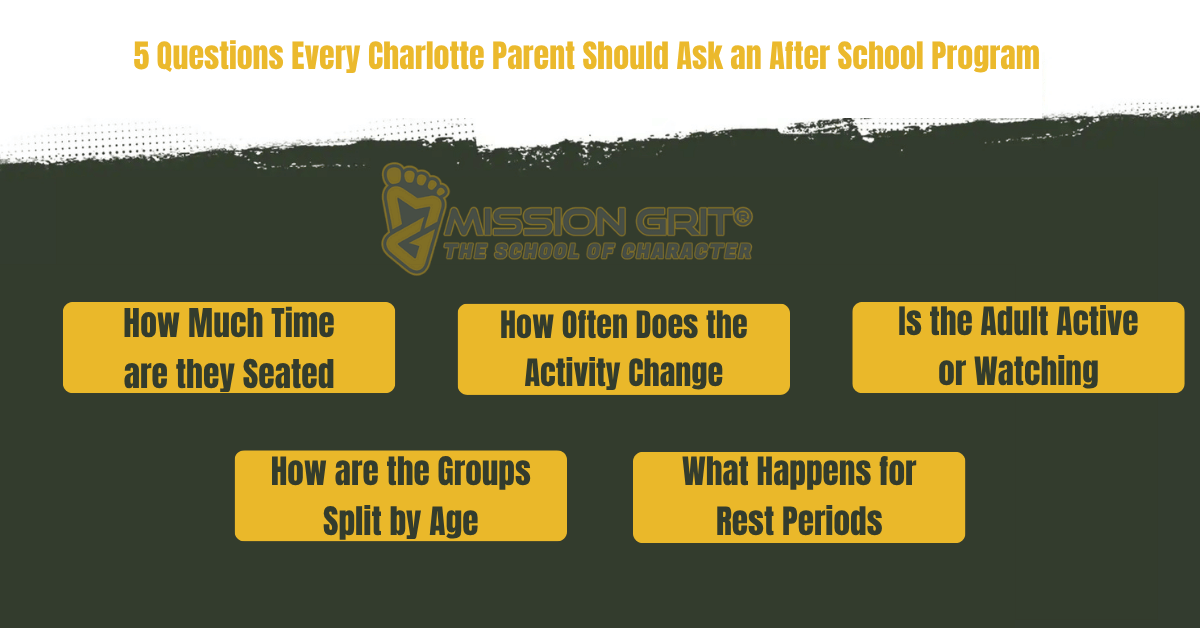
5 Questions Every Charlotte Parent Should Ask an After-School Program
Before you pay for a month anywhere, these five answers tell you most of what you need to know.
- How much of the hour is a child seated? Anything past one short block is a warning sign.
- Does the activity change week to week or repeat? Novelty inside a fixed structure is the combination you want.
- Is an adult running the activity or watching the room? Coached and supervised aren’t the same product.
- How are groups split by age? Narrow published bands beat a wide catch-all room.
- What happens when my child needs a reset mid-class? Listen for a specific story rather than a policy statement.
A program that answers all five well is worth a trial session. The answers you get on the phone matter less than what your child looks like walking out afterward.

Conclusion
An after-school program won’t treat ADHD, and nobody at Mission Grit will tell you otherwise. Diagnosis and treatment belong with your pediatrician and your care team. A well-built program can give a child a predictable hour where his body finally does what it wants to, inside a structure tight enough that he succeeds, alongside the 60 minutes of daily physical activity federal guidance recommends for every child.
Paul Plotkin founded Mission Grit on a veteran-led, whole-child model built around four layers of development—physical, mental, social, and character—as described on the About page. Classes run year-round at both the Charlotte and Fort Mill locations. If your child comes home from school wound tight and the standard homework-help room hasn’t worked, the fastest way to find out whether this format fits is to watch one class.
Try one class before you commit to a month. Bring your child to a single Xplor session in Charlotte or Fort Mill and see how the format lands. Book a trial class, or talk to the Mission Grit team about which age group and day make sense.