If you’re searching for after-school programs for non-athletic kids in Charlotte, NC, you’ve probably already had the conversation that sends most parents looking. Registration opens for soccer, or basketball, or lacrosse. You bring it up. Your kid says no. Not a dramatic no, usually. Just a quiet, settled no that’s been building since last season, when he spent time near the sideline, waiting to be subbed in.
The reflex is to treat that as a phase and sign him up anyway. But the thing you actually want — a kid who moves, has friends, and builds some grit — doesn’t take a league at all. It takes a program built for the child who won’t win the sprint and already knows it. Mission Grit runs its Xplor obstacle course classes in Charlotte and Fort Mill on exactly that premise, and this post covers what the format looks like, what it costs, and how to tell whether it fits your child.
Also Read
- How Mission Grit’s Obstacle Courses Build Confidence for Non-Athletic Kids in Charlotte
- Kids Fitness Classes in Charlotte and Fort Mill: Building Strength Without Competitive Sports
- Best Summer Camp for Shy Kids in Charlotte, NC: Building Confidence Without Competition
TL;DR
Plenty of kids aren’t in organized sports, and the ones who opt out are rarely opting out of movement. They’re opting out of being ranked in public. An after-school program for a non-athletic kid should still be physically hard, but it should replace playing time and standings with a course the whole group works through together. Mission Grit’s Xplor program runs 45-minute obstacle course classes for kids in kindergarten through 8th grade at its Charlotte and Fort Mill locations, in age-based teams, on a fixed weekly schedule. Monthly plans start at $110 for one class a week; there’s no season to commit to, and you can book a single trial class before deciding anything.
Key Points
- Non-athletic rarely means unwilling to move. It usually means a child has been compared to other kids in public and found the experience unpleasant enough to stop volunteering for it.
- Many kids sit out, and the ones who leave tell you why. In the Aspen Institute’s national survey, the top complaint among kids who’d quit was feeling “I’m not good enough,” and the average age they stopped playing was under 13.
- Cost is pushing families out too. Family spending on a child’s primary sport rose 46 percent between 2019 and 2024, which raises the stakes on a season a child isn’t enjoying.
- The ranking is the part to remove, not the effort. Obstacle course classes are physically demanding. What’s missing is the public comparison, not the difficulty.
- Cooperation changes who participates. When the group has to get everyone through a challenge, the slowest kid stops being a liability and becomes someone the team helps.
- A changing course means nobody’s permanently behind. The obstacle layout and the challenge theme rotate, so the kid who cleared it fastest last week starts even this week.
- Age-based teams keep it fair. Classes group kids by age, so a first grader isn’t trying to hold pace with a seventh grader.
- There’s no season to sign up for. Plans are monthly, so a family can test a quarter without committing to a year.
See the format before you decide anything. One class is enough to tell you how your child responds to a hard course in a non-competitive room. Book a trial class in Charlotte or Fort Mill.
What “Non-Athletic” Usually Means
Parents use the word as shorthand, and underneath it sit three very different situations.
It’s often a timeline, not a ceiling
Children develop motor skills on wildly different schedules. A nine-year-old who looks uncoordinated next to his classmates is often eighteen months behind on a curve he’ll finish anyway. The gap is real in third grade and invisible by seventh, but the child draws his conclusion about himself long before that.
It’s sometimes a temperament fit
Some children don’t enjoy performing while a crowd watches. That’s a personality trait, not a fitness problem, and it doesn’t resolve by adding another season. A kid who freezes at the free-throw line may work extremely hard in a setting where nobody’s scoring him.
It’s occasionally one bad experience that stuck
One coach, one season, one moment of being singled out in front of teammates, and a child writes off the entire category of physical activity. The Aspen Institute surveyed 3,827 young people ages 10 to 17 and found that among kids who’d stopped playing, the two least favorite things about their experience were feeling “I’m not good enough” (29 percent) and bad coaching (21 percent). The average age former players stopped participating was 12.93.
What it rarely means is a child who doesn’t want to move. Kids who describe themselves as non-athletic still climb things, still race their siblings, and still want to be strong. The interest is intact. The setting was wrong.
Where Team Sports Lose These Kids
Team sports work beautifully for a lot of children. Federal survey data reported by Aspen Institute Project Play put youth sports participation at 58 percent among kids ages 6 to 17 in 2024, a real year-over-year increase that still leaves more than four in ten kids outside organized sports. For the children team sports don’t fit, the exit tends to be predictable, and it usually comes down to five things.
Playing time is a public verdict. Every substitution is a ranking announced in front of parents. A kid who’s consistently last in gets a weekly message about where he stands, and he gets it in front of everyone he knows.
Specialization starts early. By eight or nine, many Charlotte-area leagues already include kids who’ve trained the same sport for years. A newcomer isn’t entering a level playing field, and the gap between him and the experienced kids widens for a season before it narrows.
The season structure punishes a slow start. Twelve weeks is long enough to be miserable and short enough that a child who needs time to warm up to something never gets past the awkward phase.
Cost raises the stakes on quitting. Families now spend an average of $1,016 on a child’s primary sport, a figure that’s climbed 46 percent since 2019 according to Aspen Institute Project Play research. Once a family has paid registration, bought gear, and rearranged Saturdays, quitting carries guilt, so kids stay in something they dislike.
Skill instruction assumes a baseline. Drills built around already knowing how to catch, dribble, or pace yourself leave behind exactly the kid who needs the instruction most.
None of that means your child should stop moving. Federal guidance still calls for 60 minutes or more of moderate-to-vigorous physical activity a day for children and adolescents. That number doesn’t change based on whether a kid likes basketball. School isn’t covering it either. CDC data shows only 3.7 percent of K-12 schools require daily physical education or its equivalent, which is 150 minutes a week at the elementary level. If a child has opted out of sports and the school day isn’t filling the gap, the afternoon has to provide the movement.
What to Look For in an After-School Program That Isn’t a Sport
The category of after-school activities besides sports in Charlotte is wide, and a lot of it is a sport wearing a different name. Five questions sort it quickly.
- Ask whether anyone keeps score. If the answer is yes, you’ve found a league with better marketing.
- Ask what happens when a child can’t finish something. The good answer involves a modification and a second attempt. The bad answer involves sitting out and watching.
- Ask whether the activity changes week to week. Repetition rewards the kids who were already good at it. Variation resets the field every session.
- Ask about class size and age grouping. Wide age bands with large groups almost always reproduce the dynamic your child was avoiding.
- Ask whether you can try one session first. Any program confident in its format will let you watch one before you enroll.
At Mission Grit, the answer to the second question is built into the design. The program describes itself as meeting kids where they are, “building strength, confidence, and skills step by step,” and states plainly that children don’t need prior athletic experience to join.
Not sure which day fits your schedule? Both locations set class times by age group, and the team can walk you through which one your child belongs in. See the Xplor class schedule and pricing.
Days, Ages, Locations, and Cost
Here’s the practical detail, which is usually what parents came for.
Ages and teams
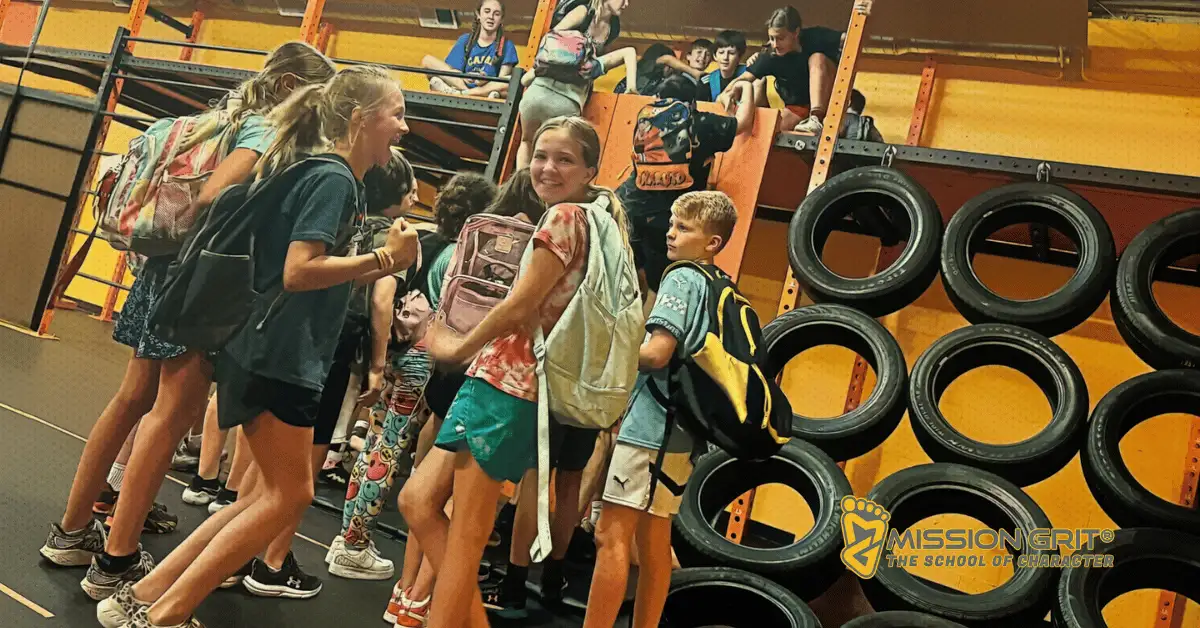
Xplor classes are built for kids in kindergarten through 8th grade, split into three age-based teams so a seventh grader isn’t outpacing a small second grader. Each class runs 45 minutes — long enough for real work, short enough that a child finishes on a win.
Days and times
At the Charlotte location, Team 1 runs 4:30 to 5:15 PM, and Team 2 runs 5:30 to 6:15 PM on both Thursday and Friday, with Team 3 at 6:30 to 7:15 PM on Thursday. Fort Mill runs the same weekday schedule and adds a Saturday morning class at 9:30 AM for the youngest team. Schedules shift with the season, so confirm your child’s slot when you book.
Cost
Monthly plans are $110 for one class a week and $145 for two. The $170 plan covers up to three classes a week, and a five-class pass is $220 if you’d rather not commit monthly. Sibling and family discounts are available, and you can cancel or pause recurring plans.
Locations
Charlotte is at 6311 Carmel Rd, Suite C, reachable at 704-733-9103 and an easy drive from Ballantyne, SouthPark, Pineville, Matthews, and Myers Park. Fort Mill is at 9499 Old Bailes Rd, Suite 205, and can be reached at 803-632-0279; it’s close to Indian Land, Baxter, and Tega Cay. Both locations run the same programs on the same course design.
How Mission Grit Fits a Kid Who Doesn’t Want to Play a Sport
The whole concept was built around this child, not adapted for him. Mission Grit is a child-development program, not a feeder into an athletic pipeline, and founder Paul Plotkin organized it around four layers of development: physical, mental, social, and character. Only one of those four is about how fast a kid runs.
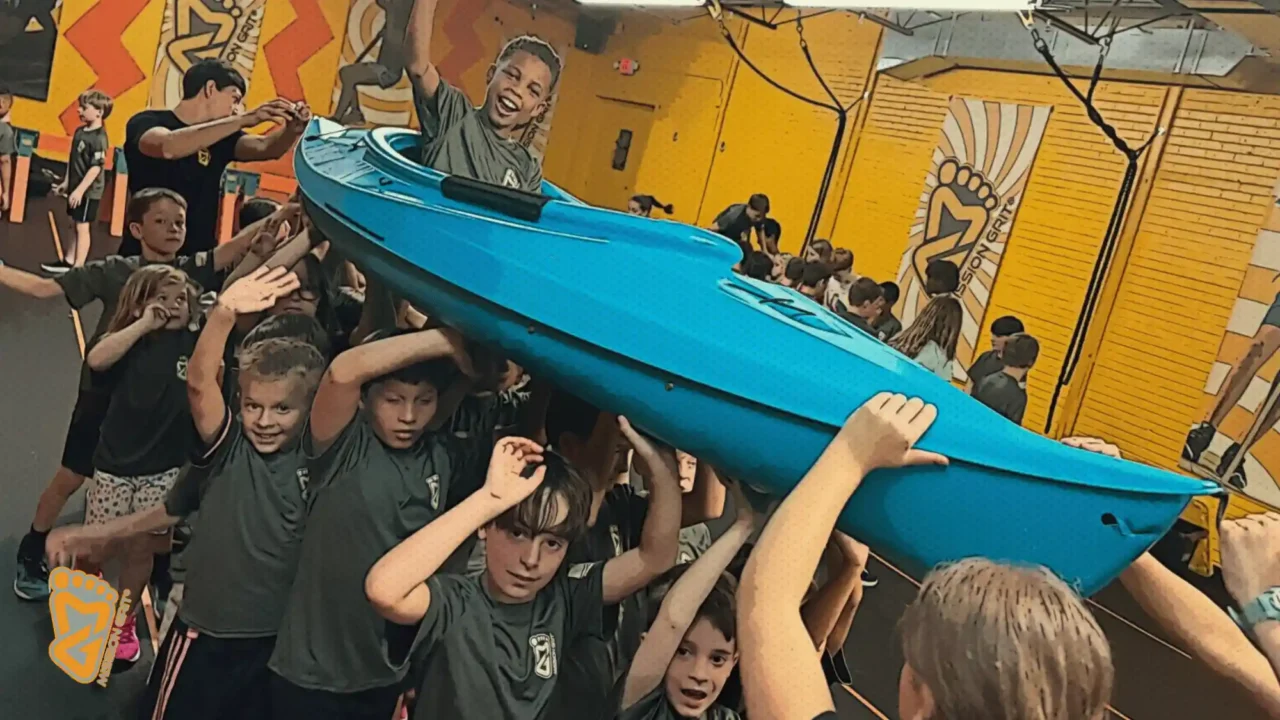
The classes run on what the program calls the S.P.I.R.I.T. method: Science, Problem Solving, In Motion, Respect, Interactive, and Teamwork. Kids work through physics and engineering challenges, mind games and quests, and collaborative problems where the group has to get everyone through. The stated goal is that children discover “real strength comes not from competition, but from cooperation,” and the classes are deliberately non-competitive.
That framing changes the social position a hesitant kid occupies. In a league, the slowest child is a cost the team absorbs. In a cooperative challenge, he’s someone the team has a reason to help—a completely different thing at ten years old.
Coaches lead every minute of class, so a hesitant child gets talked through an obstacle instead of being left to figure it out alone. Progress is measured against last month, not against the fastest kid in the room. The cargo net your child couldn’t climb in September is the benchmark, and clearing it in November is the win.
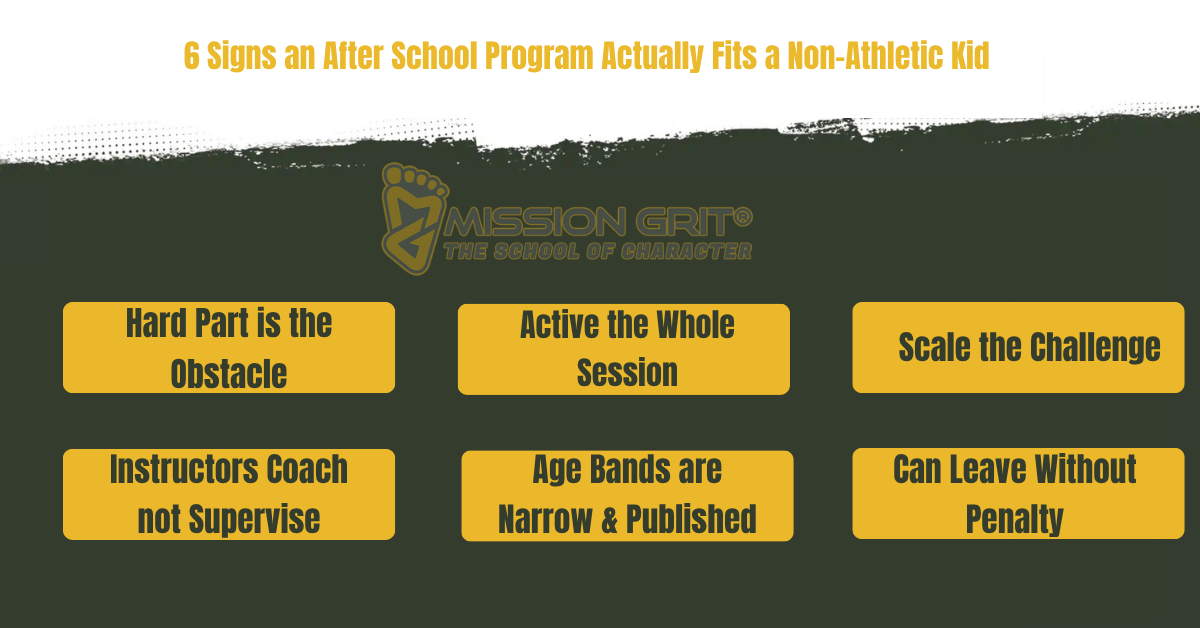
6 Signs an After School Program Actually Fits a Non-Athletic Kid
If you’re evaluating options this fall, these are the things worth checking before you pay for a month.
- The hard part is the obstacle, not the other children. Difficulty should come from the challenge itself.
- Every child is active the whole session. No rotation where half the group watches the other half.
- There’s a way to scale a challenge in place. Different heights, grips, and routes on the same course, so nobody gets moved to a visibly easier station.
- Instructors coach rather than supervise. An adult running the activity isn’t the same as an adult watching the room.
- Age bands are narrow and published. If a program won’t tell you the grouping, assume it’s wide.
- You can leave without penalty. Month-to-month beats a season commitment for a child who’s still deciding.
Any program that clears all six is worth a trial class. Most of the decision comes down to what your kid looks like in the car on the way home.

Conclusion
If your child has told you he doesn’t want to play a sport, believe him — and then keep looking. The goal was never the jersey. It was a kid who moves, gets stronger, learns to stick with something hard, and comes home with a story about it.
An obstacle course class gets close to that without the ranking attached. Paul Plotkin founded Mission Grit on a veteran-led, whole-child model, described on the About page, and the Xplor classes run year-round at both the Charlotte and Fort Mill locations for kids in kindergarten through 8th grade. The only way to know whether the format is right is to put your kid on the course once and see what happens.
Start with one class. Bring your child to a single Xplor session at the Charlotte or Fort Mill location and see how the format lands before you commit to a month. Book a trial class, or talk to the Mission Grit team about which age group and day fit your family.