The CDC and the American Academy of Pediatrics both recommend that kids ages 6 to 17 get 60 minutes or more of moderate-to-vigorous physical activity every day. Most American kids do not come close. The 60-minute recommendation is more specific than parents realize. It includes aerobic activity most days, muscle-strengthening at least 3 days a week, and bone-strengthening at least 3 days a week. At Mission Grit, we build the daily 60 minutes into a single structured session because the kids and families we work with do not have time to engineer it from scratch each evening.
This guide breaks down what physical fitness for kids actually means in 2026, why it matters past the obvious, and how Charlotte and Fort Mill families build it into a real schedule using programs like Mission Grit’s Xplor.
 TL;DR
TL;DR
Physical fitness for kids is not just about not being sedentary. The CDC’s 60-minute target is the floor, and it includes specific requirements: mostly aerobic activity, plus muscle-strengthening and bone-strengthening on at least 3 days a week each. Hitting this with school PE alone is rare. After-school programs like Mission Grit’s Xplor (obstacle courses, climbing, running, jumping, group challenges) hit all three categories at once and make the daily activity a thing kids ask for, not a chore parents enforce.
Key Points
- The CDC recommendation: 60 minutes or more of moderate-to-vigorous physical activity per day for kids 6 to 17.
- It includes 3 categories: aerobic (most of the 60 minutes), muscle-strengthening (3+ days/week), bone-strengthening (3+ days/week).
- School PE alone is not enough. Most schools provide 30 to 60 minutes of PE 1 to 3 days a week, well below the daily recommendation.
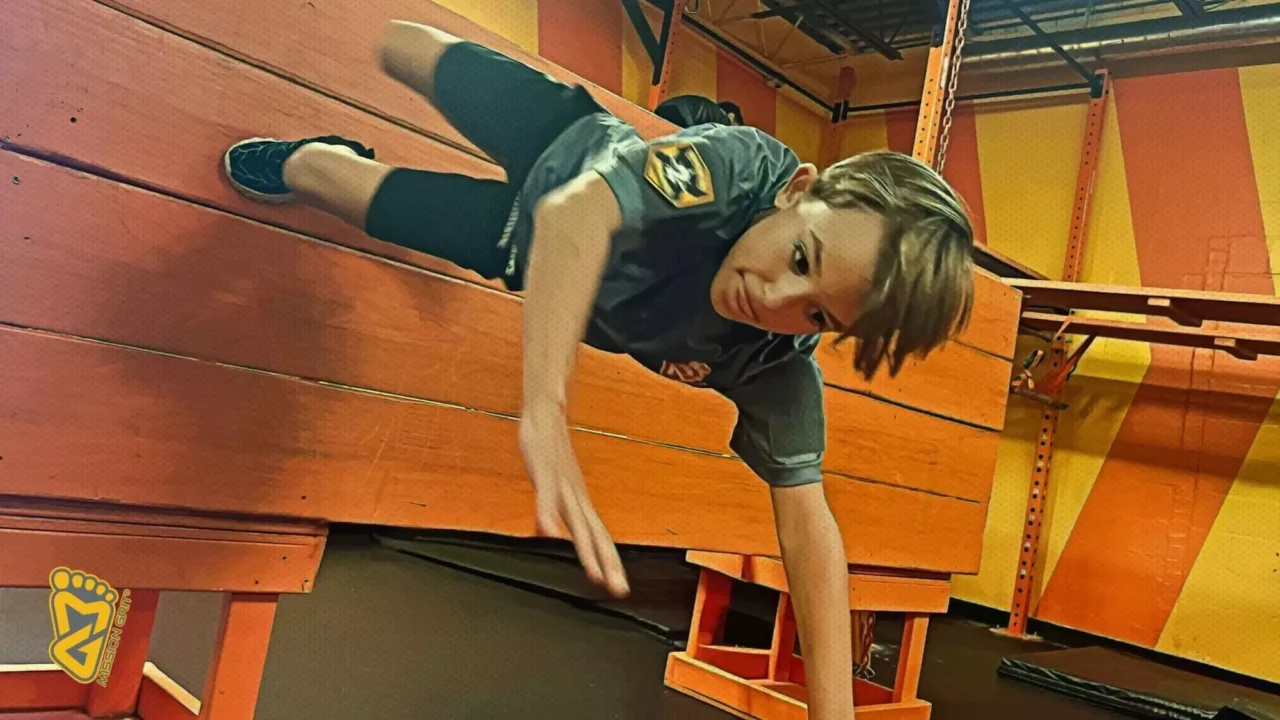
- Obstacle courses hit all three categories at once. Climbing, vaulting, and crawling build muscle; running between obstacles is aerobic; jumping and landing are bone-strengthening.
- The benefits go beyond fitness. Regular activity improves academic performance, reduces anxiety and depression, builds stronger bones, and lowers risk of type 2 diabetes and high blood pressure.
- Movement that kids enjoy gets done. A drill kids dread gets skipped; an obstacle course they ask to do again becomes daily.
- Charlotte and Fort Mill families have a structured option. Mission Grit’s Xplor program turns 60 minutes of activity into the part of the day a kid looks forward to.
| Make the daily 60 minutes the part of the day kids ask for. Mission Grit’s Xplor program in Charlotte and Fort Mill is designed to hit all three CDC categories in one session. Book a trial class. |
What the CDC Actually Means by “60 Minutes”
The headline number is the easy part. Kids ages 6 to 17 should do 60 minutes or more of moderate-to-vigorous physical activity every day. The details are where most families lose the thread.
“Moderate-to-vigorous” means activity that makes the heart beat faster. Moderate is brisk walking, bike riding, or playground play. Vigorous is running, fast cycling, sports games, or obstacle courses.
The 60-minute target breaks into three components per the CDC physical activity guidelines:
Aerobic activity. Most of the daily 60 minutes should be aerobic. Vigorous-intensity aerobic activity should happen on at least 3 days per week.
Muscle-strengthening. At least 3 days per week. For kids, this is climbing, push-ups, pull-ups, monkey bars, gymnastics, or resistance work appropriate for age.
Bone-strengthening. At least 3 days per week. Activities that produce force on the bones through impact: jumping, hopping, running, sports with jumping, gymnastics.
The 60 minutes can be cumulative across the day. A 20-minute morning bike ride, 20 minutes of recess, and 20 minutes of after-school activity hits the goal.
Why 60 Minutes Matters (Beyond the Obvious)
The headline benefits everyone knows. Cardiorespiratory fitness. Stronger hearts and lungs. The benefits that fly under the radar are the bigger story.
Stronger bones and muscles develop in childhood in a way they cannot be replaced later. Childhood is the prime window for bone density development, and the American Academy of Pediatrics notes that bone density built before age 18 is harder to add later in life.
Brain health and academic performance improve with regular activity. Physical activity improves attention, memory, and processing speed. Kids who hit the 60-minute mark tend to perform better in school.
Mental health also benefits. Regular activity reduces symptoms of anxiety and depression in kids, a finding the CDC consistently documents.
Weight and metabolic health follow the same pattern. Active kids have lower body fat and lower risk of developing type 2 diabetes, high blood pressure, and other conditions tied to sedentary patterns.
And lifelong habit formation may be the most underrated benefit. Kids who learn to enjoy physical activity become adults who maintain it. The reverse is also true.
 Why School PE Alone Is Not Enough
Most US schools provide 30 to 60 minutes of PE on 1 to 3 days per week. That covers about 30 to 180 minutes of school-based activity per week.
The CDC target is about 420 minutes per week (60 minutes times 7 days). School PE covers 7 to 43 percent of the goal at most. Recess helps but is not enough. Many schools have shrunk recess time, and recess is not always moderate-to-vigorous activity.
Sports-team practice can fill the gap, but only for kids on a team. Non-athletic kids and kids whose families do not do club sports need another structured option. The default fallback, otherwise, is unstructured screen time, which is the opposite of what fills the activity gap.
How Obstacle Courses Hit All Three CDC Categories at Once
A well-designed obstacle course is one of the few formats that delivers on all three components of the recommendation in a single session.
Aerobic component: Running between obstacles, cycling through a course repeatedly, vigorous group challenges. A typical Xplor session keeps heart rates in the moderate-to-vigorous range for the bulk of the hour.
Muscle-strengthening component: Climbing walls and ropes, vaulting boxes, monkey bars, crawling under low obstacles, bear crawls. All bodyweight, all progressive.
Bone-strengthening component: Jumping, hopping, landing from heights, running on hard surfaces. All of these produce the bone-loading impact that the CDC specifically calls for.
On top of those, the course develops coordination, balance, agility, and spatial awareness. One session, all three boxes checked. A single 60-minute Xplor session covers a kid’s daily aerobic plus that day’s contribution toward the 3+ days per week of muscle and bone strengthening.
| Anchor the week with one Xplor session. The Xplor program runs in Charlotte and Fort Mill and is built to hit all three CDC fitness categories at once. Book a trial class. |
How Mission Grit’s Charlotte and Fort Mill Programs Help Families Hit 60 Minutes a Day
The Xplor After-School Program is built specifically to hit the CDC categories. Weekly sessions provide 60 minutes of structured moderate-to-vigorous activity that includes aerobic, muscle, and bone components.
Camps fill the gaps in the school calendar. The Summer Camp, Spring Break Camp, Winter Break Camp, and No School Day Camp keep activity going during school breaks when families lose the school-day movement.
The format is the secret. Unlike running drills or boring exercise, the obstacle course is engaging enough that kids self-motivate to keep going. Movement that kids enjoy gets done. Movement they dread gets skipped.
The four-dimension framework (physical, mental, social, character) means kids get fitness alongside leadership, problem-solving, and confidence work in the same session.
Two locations serve the region. Charlotte HQ at 6311 Carmel Rd, and Fort Mill, SC. Charlotte and Fort Mill families have a structured fitness option within driving distance regardless of which side of the state line they are on. A trial class lets families test the format before committing to a recurring schedule.
What a Family Schedule Hitting 60 Minutes Looks Like
A realistic week, mapped out:
Monday. Walk to and from school plus 30 minutes of recess plus light evening play equals about 60 minutes.
Tuesday. Xplor session (60 minutes) covers the day plus that day’s strength and bone goals.
Wednesday. Recess plus a 30-minute bike ride after school equals about 60 minutes.
Thursday. Xplor session OR sports practice equals about 60 minutes.
Friday. Recess plus a family walk plus active play equals about 60 minutes.
Saturday and Sunday. Outdoor play, hiking, swimming, or family activity equals 60+ minutes. Even on the lowest-activity day, aim for the 60-minute floor.
The point is that 60 minutes a day is achievable but only with intentional structure. A weekly Xplor session is the anchor that makes the other days easier.
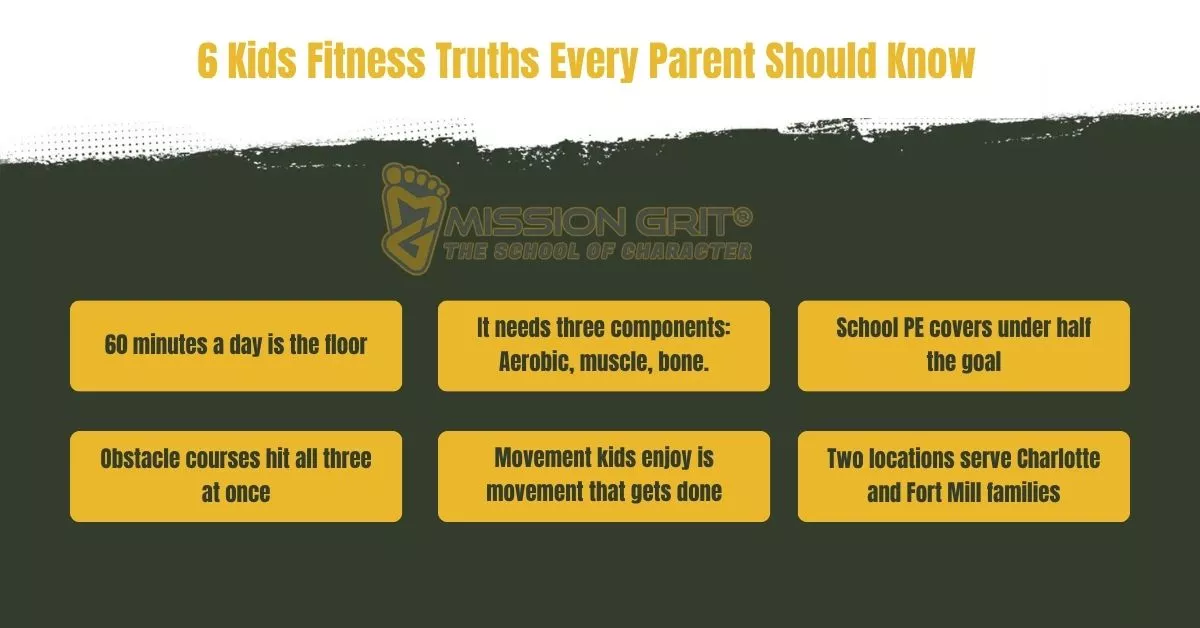
6 Kids Fitness Truths Every Parent Should Know
A reference card to keep on the fridge:
- 60 minutes a day is the floor. Not a stretch goal.
- It needs three components. Aerobic, muscle, bone.
- School PE covers under half the goal at most. Plan around it.
- Obstacle courses hit all three at once. Use them as the anchor.
- Movement kids enjoy is movement that gets done. Fun is a strategy.
- Two locations serve Charlotte and Fort Mill families. Mission Grit is the structured option.
 Conclusion
Physical fitness for kids is not negotiable, and 60 minutes a day is the floor, not the ceiling. The challenge for most families is not believing the recommendation; it is hitting it consistently. A structured program that kids enjoy turns the daily fitness goal into the part of the schedule they protect.
Mission Grit was built by founder Paul Plotkin around the four dimensions of development (physical, mental, social, character) because kids who get fit through a program they love also build mindset, leadership, and confidence in the same hour. The Charlotte and Fort Mill teams run the program for the families who want one anchor that does all four jobs.
| Build the Xplor program into your kid’s week. Book a trial class, or reach out to the Charlotte team or the Fort Mill team to find a time that fits your family’s schedule. |