Most kids’ team building events and activities top out at “win the relay race” or “build the marshmallow tower.” Fun, but they do not teach leadership in any lasting way. Real leadership development for kids requires structured challenges where someone has to make a decision, communicate it, and own the outcome. The activities have to be hard enough that figuring it out matters. At Mission Grit, we design every team building event around that principle, because the kids who walk out of a Charlotte or Fort Mill session changed are the ones who actually had to lead something during the hour.
This guide explains what makes a team building event actually leadership-developing, what Mission Grit’s Charlotte and Fort Mill events look like, and which kinds of groups (school classes, scout troops, sports teams, youth groups) get the most out of them.
TL;DR
Team building done well builds leadership skills that show up at school, at home, and on the field. Mission Grit’s team building events use obstacle courses, group challenges, and trust-based scenarios to put kids in real decision-making moments. Game-based leadership training has been shown to improve skill retention by up to 25 percent over traditional classroom approaches. Charlotte and Fort Mill groups (school classes, scout troops, sports teams, youth groups, family events) book Mission Grit for events that produce visible behavior change, not just photos.
Key Points
- Real leadership requires real decisions. A team building activity that does not force decisions does not develop leaders.
- Game-based training improves retention by up to 25 percent over traditional sit-and-listen leadership lessons.
- Trust-building is the foundation. A blindfolded course-running drill teaches kids to trust their teammate’s voice, which is the prerequisite for following any leader.
- Communication under pressure is the test. Kids who can communicate clearly when stressed lead naturally; the obstacle course is the pressure environment.
- Rotating roles is non-negotiable. Every kid takes the leader seat at some point, not just the kid who was already vocal.
- Debrief is where the learning sticks. A 5-minute structured reflection after each challenge converts experience into a lesson the kid carries home.
- Mission Grit serves Charlotte and Fort Mill groups specifically. Schools, scout troops, sports teams, youth groups, and family events all book the team building format.
| Book a team building event your kids will still be talking about next month. Mission Grit’s Charlotte and Fort Mill teams build custom events around your group’s specific goals. See team building options at Mission Grit. |
What “Real” Leadership Development Looks Like (vs. Generic Team Games)
The difference between a generic team game and a leadership-developing one is structure.
A generic team game looks like a relay race where the fastest team wins. It is fun, but the leadership content is “run faster.” A leadership development event looks like a relay race where one teammate is blindfolded, one cannot speak, and one cannot use their dominant hand. Now the team has to communicate, plan, and lead each other through it. The fastest team is the one with the best leader, not the best athlete.
The structural difference is constraint design. Real leadership challenges have constraints that force communication, decision-making, and role-clarity. Generic team games do not. The American Academy of Pediatrics writes about social-emotional development the same way: it shows up when kids face genuine problems they have to solve in coordination with others, not when they win an unstructured contest.
For kids specifically, this matters because they learn leadership by being put in situations where leading makes a measurable difference. Mission Grit designs every challenge around that principle.
 What a Mission Grit Team Building Event Looks Like
The format runs 90 minutes to 3 hours, depending on group size and goals. The Charlotte HQ accommodates groups up to about 30, and larger groups can split or book consecutive sessions.
The arc of an event is intentional. It opens with a brief framing from the lead instructor on the day’s leadership theme: communication, decision-making, supporting teammates, or whichever skill the booking organizer chose. Kids understand what they are practicing, not just what they are doing.
The trust-building round comes next, often a blindfolded obstacle course or a verbal-only puzzle where one half of the group can see and one half can touch. Kids feel what trust requires before they earn it.
Then comes the communication challenge: group-based puzzle solving where the only way through is verbal coordination. Kids who default to physical execution learn to slow down and talk.
A leadership rotation follows. Every kid takes a turn as the designated leader for at least one challenge. Quiet kids get the seat. Loud kids learn to follow.
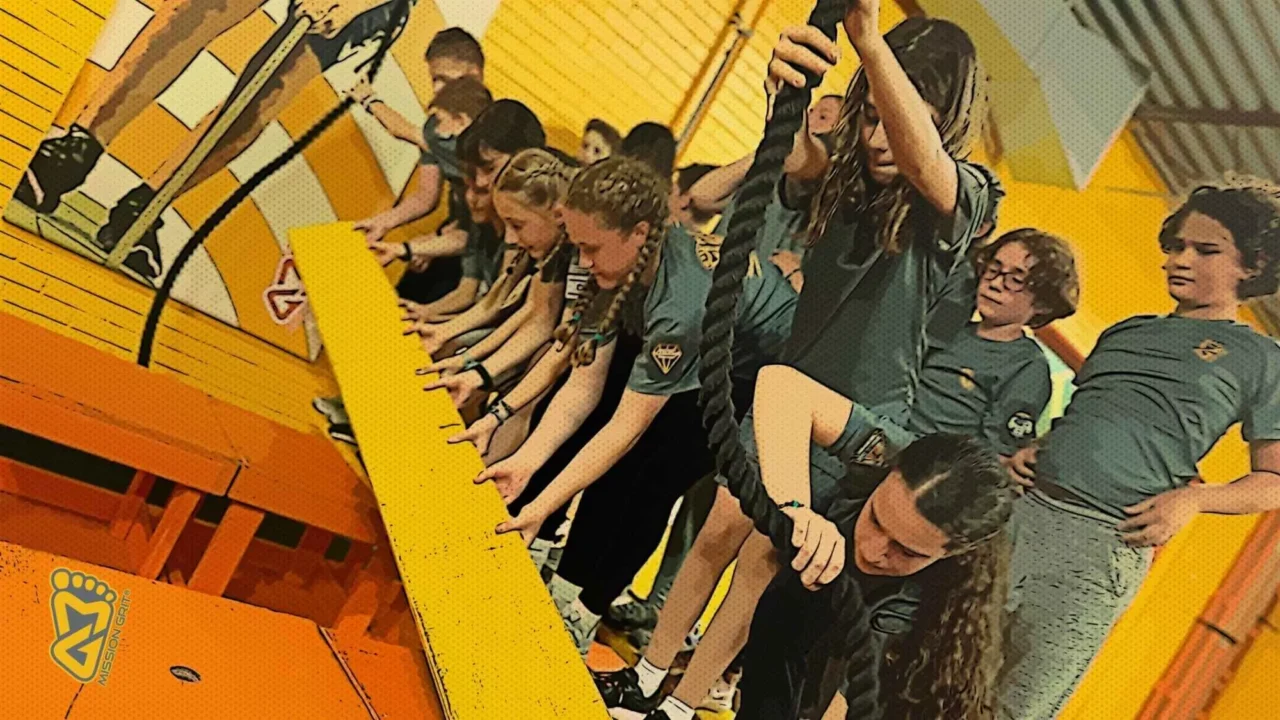
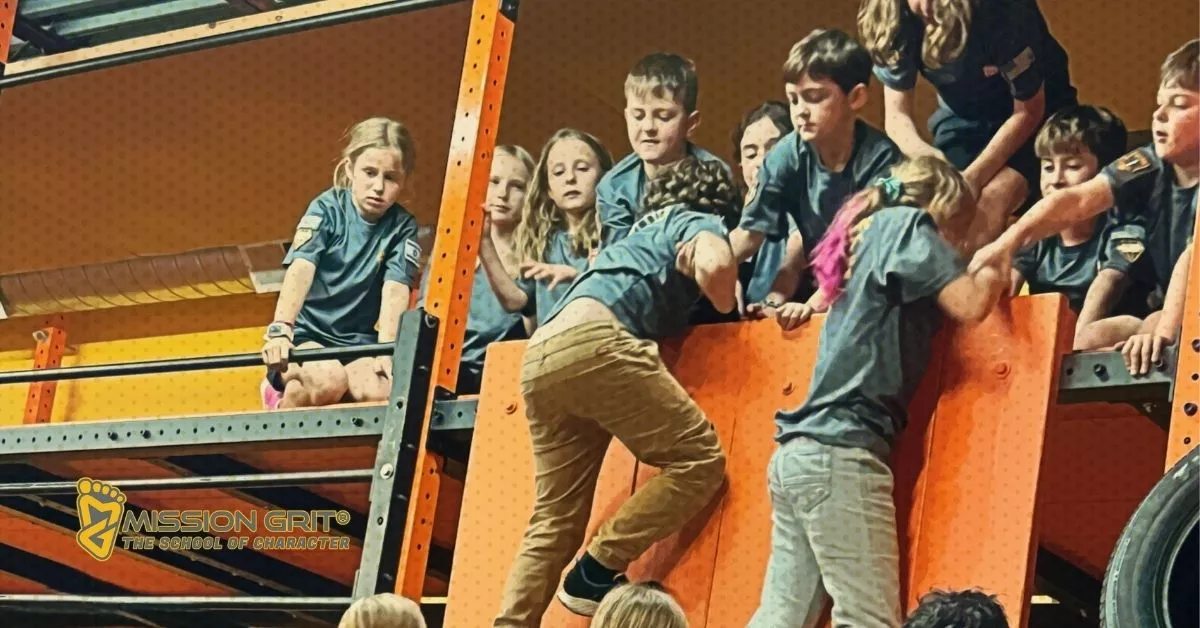
The capstone is the full obstacle course, completed as a group with mid-course leadership swaps and a time goal. Kids see what their team can do when they apply what they just practiced.
A closing debrief of 5 to 10 minutes wraps the session. Kids name what worked, what did not, and what they want to take back to school, home, or their team. The debrief is where the experience converts into a lesson the kid carries out the door.
Which Groups Get the Most Out of It
The event format adapts to a wide range of group types.
School classes (4th to 8th grade is the sweet spot for team building): End-of-year celebrations, character education days, advisory group bonding. Teachers see the dynamic shift in their classroom for weeks afterward.
Scout troops (Cub Scouts, Boy Scouts, Girl Scouts, Trail Life): Earns toward leadership and physical fitness merit and award requirements. Aligns directly with scouting’s leadership development goals.
Sports teams (off-season or pre-season): A team that learns to communicate on Mission Grit’s obstacle course will communicate better in their actual game. Coaches book this as a pre-season foundation.
Youth groups (church, community, civic): Builds belonging and shared experience for groups that want depth beyond pizza parties.
Family events and multi-generational birthdays: Cousins, siblings, and friends from different schools can connect through shared challenges they have never tried before.
Home-school co-ops: A scheduled team building event becomes a regular cooperative learning anchor for the year.
| Bring your scout troop, class, or team to a custom event. Mission Grit instructors talk with the booking organizer before the event to tailor the leadership theme to your group’s specific situation. Book a team building event. |
What the Research Says
The case for game-based leadership development for kids is well documented.
Game-based leadership training outperforms traditional models in skill-building outcomes and improves retention by up to 25 percent compared to lecture-based or workbook-based leadership programs. Trust-based activities build the foundation of leadership, because trust precedes followership, and followership is what makes a kid’s leadership effective.
Communication is the most teachable leadership skill in childhood, per the American Academy of Pediatrics. Kids who practice clear verbal communication under pressure carry that into school presentations, group projects, and team sports.
Confidence and self-esteem grow with leadership practice. Kids who get the leader seat, even briefly, develop a willingness to volunteer for it next time. And group physical activity has dual benefits: it develops the leadership skill AND meets the CDC’s recommendation of 60 minutes of daily moderate-to-vigorous activity for kids 6 to 17.
How Mission Grit’s Charlotte and Fort Mill Programs Deliver
Mission Grit operates two locations. Charlotte HQ at 6311 Carmel Rd, plus the Fort Mill, SC location. Both are equipped for team building events and can be booked for private group sessions through the Charlotte contact page or the Fort Mill contact page.
Every event is customized to the group’s goal. Mission Grit’s instructors talk with the booking organizer (teacher, scout leader, coach, parent) before the event to tailor the leadership theme and challenges to the group’s specific situation.
The framework is built on four dimensions of development: physical, mental, social, and character. Leadership development sits in the character pillar, and the four-dimension model anchors every team building event.
Founder Paul Plotkin built Mission Grit’s curriculum specifically to give kids real-stakes leadership reps in a safe, supportive environment. The full backstory on the program’s design lives on the Mission Grit about page.
 6 Team Building Truths Every Parent or Group Leader Should Know
A quick reference for the next time you are planning a group event:
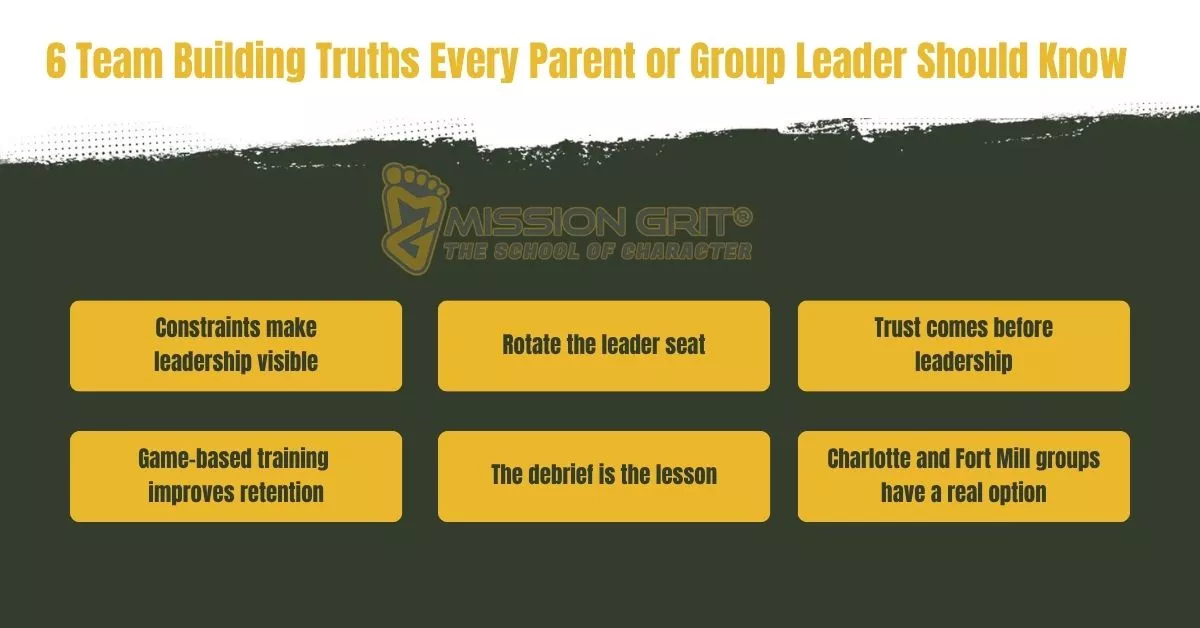
- Constraints make leadership visible. Without them, the activity is just a game.
- Rotate the leader seat. Quiet kids need the practice more than loud ones.
- Trust comes before leadership. Build it first, then test it.
- Game-based training improves retention by up to 25 percent. Lectures cannot match it.
- The debrief is the lesson. Skip it and the event becomes a memory, not a skill.
- Charlotte and Fort Mill groups have a real option. Mission Grit is built for it.
 Conclusion
A team building event is only worth doing if the kids leave with something they can use. Mission Grit’s events are designed around real leadership reps, not generic group games, and the difference shows up in how the kids communicate, decide, and support each other afterward.
Mission Grit was built by founder Paul Plotkin around the conviction that kids develop leadership the same way they develop any other skill: with real reps, structured feedback, and a coach who knows what they are looking for. The Charlotte and Fort Mill teams take that conviction into every booking, and the result is groups that walk out tighter than they walked in.
| Book a Mission Grit team building event for your group. Visit the team building events page to see options, or contact the Charlotte team or the Fort Mill team to plan your event. |