
Planning school field trips in Charlotte, NC, tends to circle the same short list. A museum, a science center, a historic site, a theater. All good options, and all built around the same basic shape: a class walks in, sits or shuffles for ninety minutes, listens to a docent, and gets back on the bus. For a fourth-grade class in April, that’s a long time to hold still in an unfamiliar building.
A second category of trip rarely gets priced out: the active day. Same bus, same permission slips, same time block, except the students spend the whole session physically working through an obstacle course and a set of team challenges, with an instructor running the room. Mission Grit hosts private team-building events for school groups at both its Charlotte and Fort Mill locations, and this post covers what the day involves, what it costs, and when to book it.
Also Read
- Team Building Events for Kids: Charlotte, NC and Fort Mill, SC
- Kids Obstacle Course Classes in Charlotte: What the Xplor Program Looks Like
- Obstacle Courses for Kids in Charlotte, NC and Fort Mill, SC
TL;DR
Mission Grit hosts private, instructor-guided sessions for school classes and youth groups at two locations, Charlotte and Fort Mill. The basic package runs 60 minutes and costs $280 for the first 10 participants, plus $20 for each additional participant, which puts a standard elementary class in the $500 to $650 range. The space is 100 percent private. You can tailor the course and challenges to your grade level and goals, and instructors lead the entire session, so teachers and chaperones don’t have to run activities. You can also extend or adjust events if your schedule allows more than an hour.
Key Points
- The whole session is active. Students are on the obstacle course and in team challenges rather than seated for a presentation. For a class that’s been testing all week, that’s the entire point.
- Your group has the space to itself. Bookings are 100 percent private, so you’re not sharing the floor with a birthday party or a walk-in crowd.
- Instructors run it, not your chaperones. Mission Grit coaches lead every part of the session. Teachers supervise their students and otherwise get to watch.
- It’s customizable. The team can adjust the course layout and the challenges to your grade level and to what you want out of the day, whether that’s cooperation, problem-solving, or communication.
- Pricing is transparent and per-head after the first ten. $280 covers the first 10 participants, and each additional participant is $20.
- Sixty minutes fits a field trip block. One hour on site fits cleanly into a half-day trip with bus time on both ends, which most elementary schedules can absorb.
- The movement gap in schools is real. SHAPE America recommends 150 minutes of instructional physical education a week for elementary students, and very few schools hit it.
- Two locations serve both sides of the state line. Charlotte on Carmel Road and Fort Mill on Old Bailes Road, so schools in Mecklenburg and York counties both have a nearby option.
Get your date range checked before the calendar fills. You’ll sort out availability, group size, and customization in one short conversation. See team-building event details and pricing.
Why Most Charlotte Field Trips Leave Kids Sitting
Charlotte-Mecklenburg Schools serves roughly 140,000 students across 185 schools, which means many buses head to a fairly small set of destinations every spring. Most of those destinations are viewing experiences.
Museums, exhibits, and performances are built around observation, and they’re valuable. But they ask for the same posture the classroom already does. A class that’s been on a bus and then in a quiet gallery for two hours is going to be loud somewhere, and it’s usually on the ride back.
Teachers also recognize a participation problem immediately. In a lecture-format visit, the students who already participate do, and the rest coast through the morning. An active trip flips who stands out. In a team challenge, the student who never raises a hand in class is frequently the one who works out how the group gets everyone over the obstacle.
The research backs this up. In a randomized study of school tours reported in Education Next, students who took the trip showed measurable gains in critical thinking, historical empathy, and tolerance compared with students who didn’t, and the effects were substantially larger for students from high-poverty and rural schools. The trip itself did work the classroom hadn’t.
What an Obstacle-Course Field Trip Day Looks Like
The basic package is 60 minutes, and it moves through four stages.
Arrival and briefing
Instructors set expectations, walk the group through the safety rules, and split the class into teams. This is the only part of the hour where students stand still, and it’s short on purpose.
The obstacle course
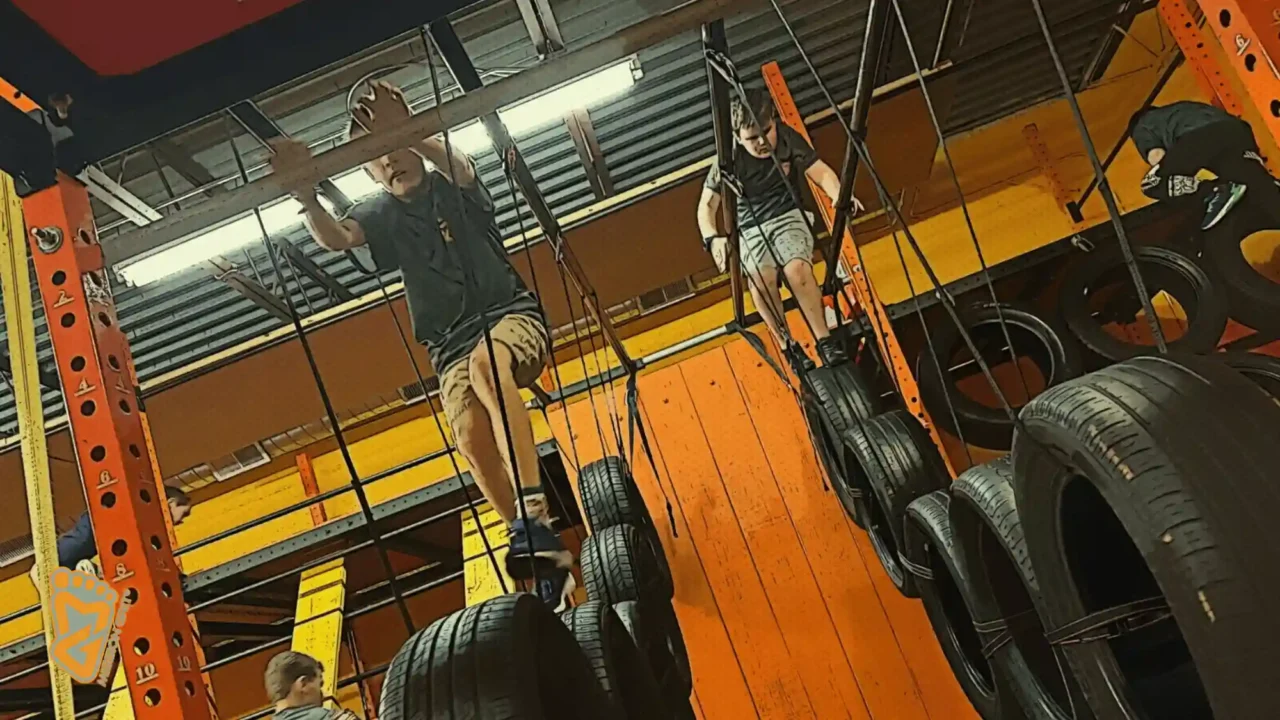
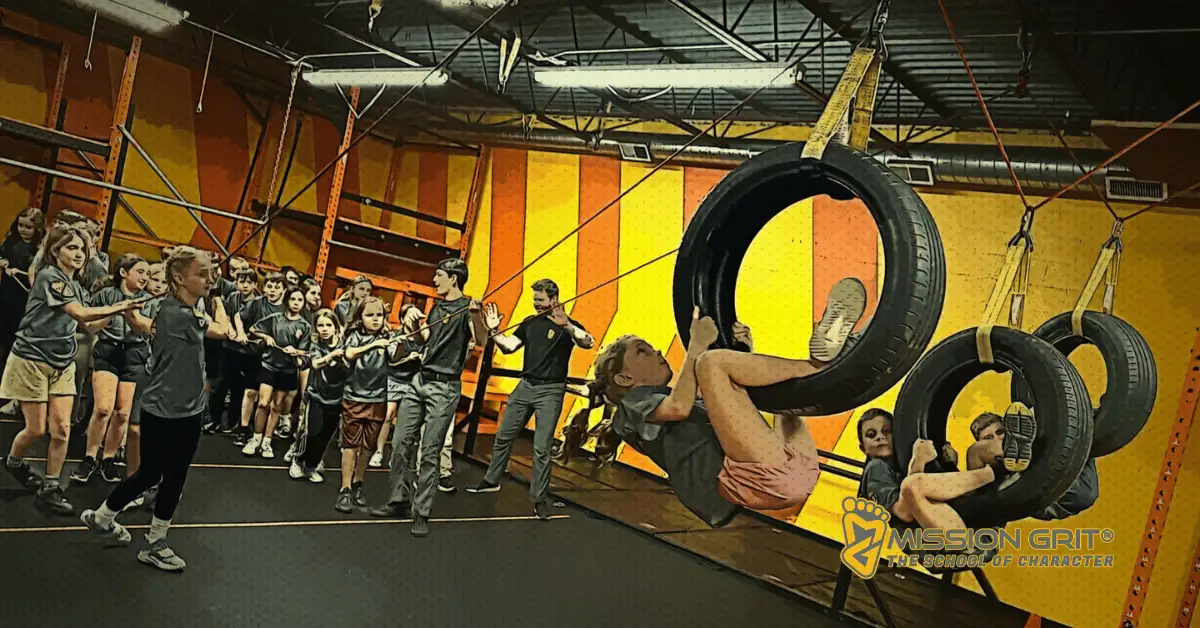
Students run a professionally designed indoor course built for their grade level, with coaches guiding them through and modifications available for any student who needs one. Because a course runs at different heights, grips, and routes, a child who needs an easier version gets it in place instead of being pulled to a separate station where the whole class can see.
Team challenges and quests
Scenario-based problems the group solves together, built on Mission Grit’s S.P.I.R.I.T. method: Science, Problem Solving, In Motion, Respect, Interactive, and Teamwork. Relay challenges and communication tasks sit in this block, and they’re structured so the group succeeds together rather than sorting itself into a ranking.
A structured close
The session ends with a debrief rather than a scramble for the bus, so the day gives the teacher something to refer back to in the classroom on Monday.
Want the hour built around a specific goal? Tell the team whether you want the emphasis on teamwork, problem-solving, or confidence, and they’ll build the challenges around it. Talk to the Mission Grit team about your group.
Group Size, Timing, and Cost
This is usually the section that decides whether a trip makes it onto the calendar, so here’s the arithmetic.
- The base rate is $280 for the first 10 participants. Each additional participant is $20.
- Worked example, class of 22. $280 plus 12 additional participants at $20 each comes to $520 total.
- Worked example, class of 28. $280 plus 18 additional participants at $20 each comes to $640 total.
- The basic package runs 60 minutes. You can extend or customize events if your schedule allows more.
- Team-building events are for ages 6 and up.
- Both locations. Charlotte at 6311 Carmel Rd, Suite C, 704-733-9103. Fort Mill at 9499 Old Bailes Rd, Suite 205, 803-632-0279.
Booking is a conversation, not a checkout form. You confirm availability directly with the location team by phone or email, and that’s when you set your group’s customization and lock in your total.
Scheduling Around the School Calendar
Book earlier than feels necessary. Spring is the heaviest field trip season around Charlotte, and weekday morning slots go first in both districts.
The post-testing window is the strongest fit. Classes coming off an assessment stretch benefit most from a fully physical day. It’s also the easiest booking to justify to an administrator, because nobody’s giving up instructional time that would have been productive anyway.
Start-of-year trips do different work. A September or early-fall booking works as a team-formation tool, useful when a teacher wants a class to gel before the academic pressure starts.
Teacher workdays and no-school days are worth asking about. If your group is a club, troop, or church group rather than a school class, those dates open up weekday availability the schools can’t use.
Have your numbers ready. A firm participant count, the grade level, and a preferred date range make the first phone call short.
Which Groups This Works For
Mission Grit lists team-building events as a fit for nonprofit organizations, sports teams, religious groups, Boy Scouts, Girl Scouts, kids’ clubs, schools, and families. In practice, a few use cases come up most often.
School classes, elementary through middle school. The core booking, with course difficulty set to the grade.
Scout troops. Troops and packs use the format for cooperation and leadership work that maps neatly onto badge requirements.
Church and youth ministry groups. A private booking makes it straightforward for groups that want their own space and pace.
Youth sports teams in the offseason. A cross-training day that builds cohesion without adding sport-specific volume.
One thing worth knowing up front: Mission Grit works exclusively with children and doesn’t host adult team-building events; its focus and mission stay fully dedicated to youth development. If you’re looking for a staff day, this isn’t the venue. If you’re looking for a room designed entirely around kids, that’s exactly what it is.
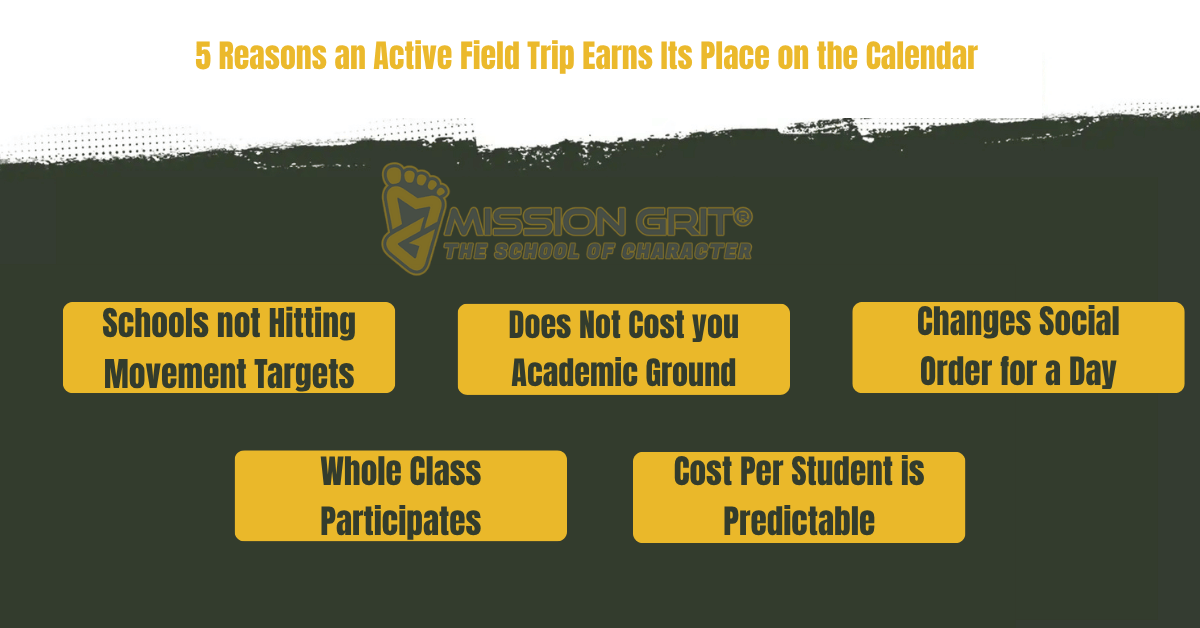
5 Reasons an Active Field Trip Earns Its Place on the Calendar
Teachers usually have to defend a trip to somebody. These arguments hold up:
- Schools aren’t hitting the movement targets. SHAPE America recommends 150 minutes a week of instructional physical education for elementary students, and CDC data shows only 3.7 percent of K-12 schools require daily physical education or its equivalent.
- Physical activity doesn’t cost you academic ground. A CDC review of 50 studies on school-based physical activity found that recess has a positive or neutral relationship with attention and on-task classroom behavior, and that adding physical education time doesn’t appear to hurt academic performance.
- It changes the social order for a day. Cooperative challenges bring to light students who are invisible in a lecture setting.
- The whole class participates the entire hour. No rotation where half the group watches while the other half does the activity.
- The cost per student is predictable. Twenty dollars a head past the first ten, with no surprise add-ons on a basic package.
Any one of those makes the case on its own. Together they turn an active day from a treat into a defensible use of instructional time.

Conclusion
A field trip is one of the few days a year a teacher gets to change what the class experience feels like. Spending it in a room where every student is physically working, solving something with a team, and finishing on a win is a reasonable use of that day. And the evidence that trips outside the classroom do real work is stronger than most planners realize.
Paul Plotkin founded Mission Grit on a veteran-led, whole-child model built around four layers of development—physical, mental, social, and character—as described on the About page. Sessions run at both the Charlotte and Fort Mill facilities, the space is private to your group, and coaches run the hour, so your chaperones don’t have to.
Get your class on the calendar. Bring your date range, your group size, and what you want students to walk away with, and the team can confirm availability and your total in the same call. See team building and field trip details, or contact the Charlotte or Fort Mill location directly.